24/11/2025


Several articles related to the *n-Dame_Heritage* project were published in 2025, reflecting ongoing methodological and scientific advances in documentation, semantic integration, and data-driven interpretation of the Notre-Dame de Paris corpus. Here is a selection :
Guillem A., Abergel V., Roussel R., Comte F., Pamart A., De Luca L. Bridging the Provenance Knowledge Gap Between 3D Digitization and Semantic Interpretation. Heritage, Vol. 8(11), 2025. https://doi.org/10.3390/heritage8110476
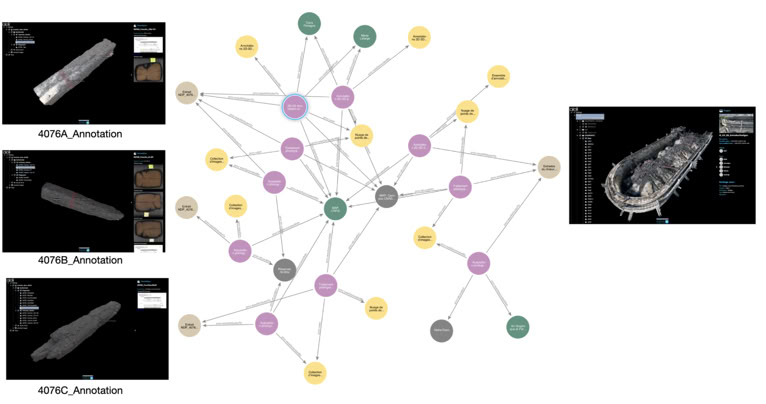
This paper proposes an integrated framework for representing the provenance, transformation steps, and interpretative contexts of 3D digitisation workflows. By embedding provenance and context into the documentation process, the authors demonstrate how semantic models can improve traceability, interoperability, and multi-temporal reuse of heterogeneous 2D, 3D, and documentary datasets, with case studies drawn from the scientific corpus of Notre-Dame de Paris.
Arese P., Roussel R., De Luca L. Establishing a Dialogue Between Textual Sources and 3D-Spatialised Annotations: A First Experiment Within Notre-Dame’s Scientific Data Corpus. The International Archives of the Photogrammetry, Remote Sensing and Spatial Information Sciences, Vol. XLVIII, 2025, pp. 49–56. https://isprs-archives.copernicus.org/articles/XLVIII-M-9-2025/49/2025/
This study addresses the methodological challenge of linking narrative historical sources with structured 3D annotations, proposing an initial framework for reconciling the precision of spatialised data with the contextual depth of textual records. It illustrates how integrated documentation can bridge semantic and geometric dimensions in heritage science.
Roussel R., De Luca L., Guillem A., Comte F. A Cathedral of Spatialised Annotations Portraying the Multidisciplinary Study of Notre-Dame de Paris. In: Digital Heritage 2025, The Eurographics Association, 2025. https://doi.org/10.2312/dh.20253126
This contribution explores spatialised annotations as epistemic objects that embed expert activity within spatial, temporal, and semantic contexts. Using the interdisciplinary Notre-Dame worksite as a case study, the authors show how large-scale annotation frameworks can structure, visualise, and query observations across disciplinary boundaries.